AUTHOR: WALEED SAFI
“Our task here is to rescue artworks, archives and stories before they disappear in yet another war.” Sultan Sooud al-Qassemi uses his fortune and his connections to track down the Arab world’s masterpieces.
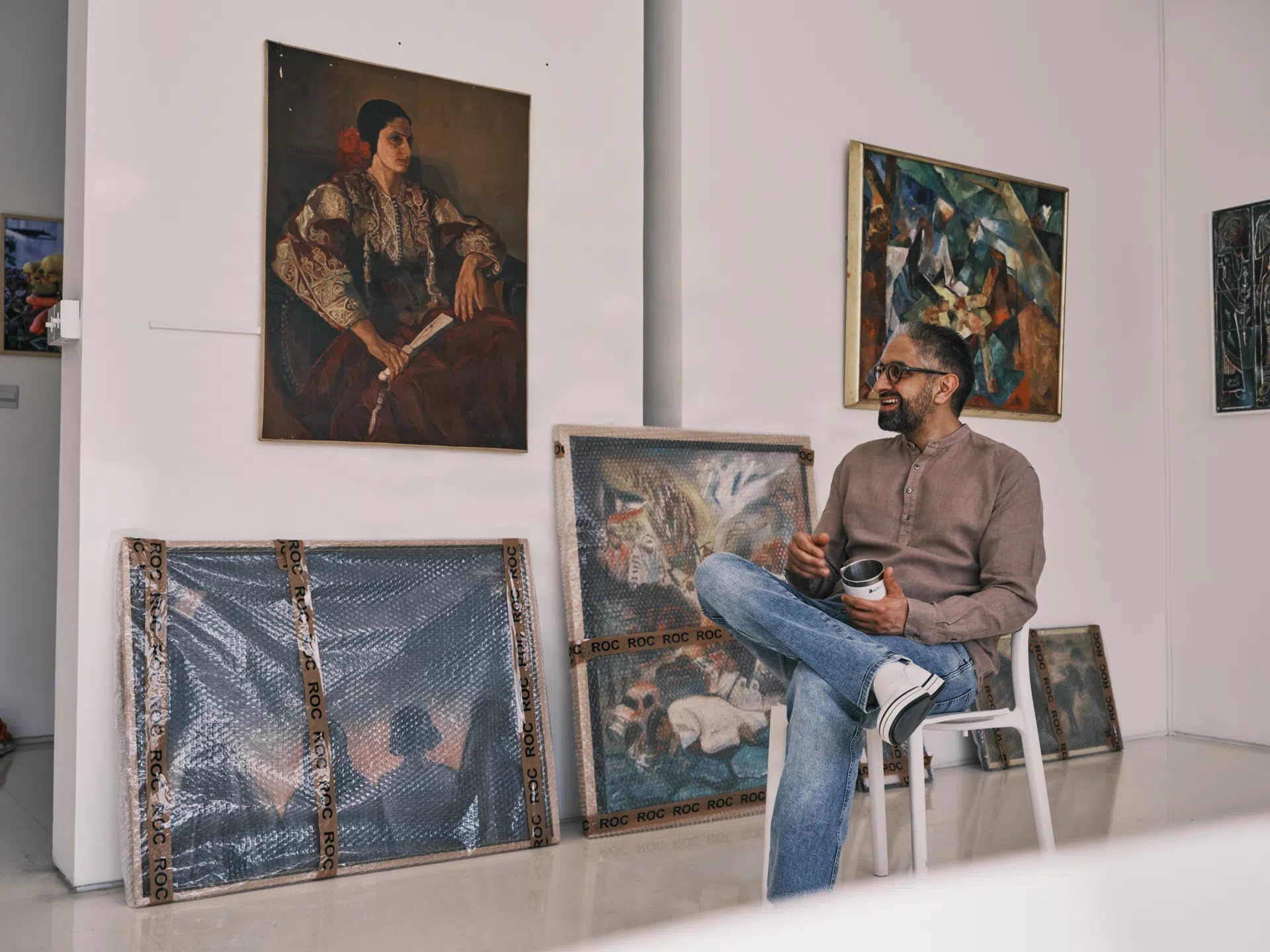
DUBAI – In a few hours, Sultan Sooud al-Qassemi is due to speak with a 99-year-old Lebanese artist in Beirut. He does not know whether she can still remember her life, or whether old age has blurred her memory of the paintings she once created, the people she knew, the places where she exhibited, and the wars she survived.
But he has to try. He has made it his mission to track down forgotten Arab artists. It often begins with a name, a rumour of a painting in a private apartment, a shuttered studio, or a son holding the key to an archive that has not yet been lost.
Sultan Sooud al-Qassemi, 48, is an art collector, yes. But the label does not quite cover it.
“ABDULLAH!” he suddenly exclaims, clutching his head.
Abdullah is one of al-Qassemi’s assistants. He is sitting on a sofa in the corner of the office, working.
“Have we confirmed the appointment with the woman in London?”
It is summer in the United Arab Emirates, and outside the heat has turned the world yellow, as if the Gulf state had been struck by an atomic bomb. Inside, in the cool air conditioning, al-Qassemi sits behind the desk in his office in a robe, his headscarf laid over his head and a pair of white sneakers poking out from beneath the hem. He presides over one of the world’s largest collections of modern Arab art – more than 2,000 pieces – but he does not sound like a man who is yet satisfied with his achievements. When he talks about art, his body moves with him. His shoulders draw together a little tensely, he leans forward, and the words come quickly, with the quivering sense that something important is at stake.
“ABDULLAH! Have we forgotten the catalogue?” he suddenly says, pressing his fingers to his temple.
“Send a driver for the catalogue, please,” he says.
The large office has the character of a waiting room, a salon and a control tower all at once. Assistants come and go with folders under their arms. Two European guests are wrapping up a meeting with al-Qassemi; they sit hunched forward and attentive, as though in the middle of a diplomatic negotiation. Messages and emails tick in on the computer: artists, curators and institutions in London, Cairo, Beirut, Paris and Marrakesh.
Around al-Qassemi are paintings wrapped in bubble wrap, magazines, books, invitations, handwritten notes and lists of names that must not be forgotten. Artists to be interviewed. Conversations to be followed up on. People to be invited, thanked and perhaps, when the time comes, repaid.
He conducts several conversations at once. He talks with the Europeans, answers the assistants, interrupts himself, and talks again.
“We are heading for the villa in Dubai, get a driver ready,” he says, looking at me.
“After all, we have a special envoy from the land of Louisiana.”
Al-Qassemi declares it playfully across the whole room to the assistants, as if the museum in Humlebæk were the only thing Denmark is known for in his universe.
SULTAN SOOUD AL-QASSEMI, born 1 January 1978, carries many titles: Emirati art collector, lecturer, thinker, commentator and columnist. He belongs to the al-Qassemi dynasty, the royal family that has ruled Sharjah – one of the seven emirates that together make up the United Arab Emirates – since 1727.
As a relative of Sharjah’s ruler, Sheikh Sultan bin Muhammad al-Qassemi, he also bears the title of sheikh. He is not among the United Arab Emirates’ rulers or crown princes and has no place in the government, but his cultural and intellectual influence is considerable.
Above all, he is known as the man behind the Barjeel Art Foundation.
In a Middle East where decades of wars, dictatorships and state collapse have scattered artists, paintings and archives across continents – or pushed them into oblivion – the Barjeel Art Foundation is trying to save modern Arab art from disappearing along with them.
Through Egyptian friends from circles working with cultural heritage, architecture and the restoration of Islamic monuments, I had an indirect connection to al-Qassemi. When I wrote to him and said I was in the Emirates, he replied quickly: he had time. I meet him over several days to understand his driving force, his thinking and his universe. What does he think about art, museums and freedom of expression? What stereotypes does he encounter as a royal Arab art collector? And what does it actually mean to try to rescue an art history?
Around Qassemi there is also something else, say people who know him: an intellectual free space that comes into being in his villa. There he hosts dinner parties where artists, writers, curators, poets and other creative forces from the region meet. Over time the gatherings have become so legendary that even Esquire Magazine has written about them.
In the back seat of the car on the way home to the villa, al-Qassemi opens his laptop and disappears for a while into his work. The screen lights up his face, and in that moment it is as if he shuts out the world. It is his break, so I leave him be. Outside, the sun sinks lower; the world is no longer yellow, and Dubai’s skyscrapers glide soundlessly past the thick windows, as if the whole city has been put on mute.
Personally, I have been fascinated by al-Qassemi since 2011. He was a rare figure: sharp, passionate and courageous, but also unpredictable. He came across as someone who actually tried to think in public, which is rare in the Arab world, and he also shattered all the categories available from the outside when one tried to describe a Gulf Arab royal. They rarely speak to the media, and even more rarely with a voice that feels free. But his Twitter account was named by Time Magazine as one of the world’s best, and it was not hard to understand why.
In the middle of a chaotic and historic time, he wrote frequent updates marked by clear-sightedness. He criticised Egypt’s Hosni Mubarak and the Egyptian generals, even though they were allies of the royal family in the Emirates. And he described the Arab uprisings as a moral defeat for al-Qaeda’s jihadist worldview: the demonstrators in Tunis, Cairo and Damascus were not demanding a caliphate, but dignity, freedom and the right to political change.
For many Westerners who at the time were trying to understand the revolutions, the protests and the new political energies in the Middle East, al-Qassemi became one of the first interpreters who made the developments comprehensible. He translated the events intellectually. On social media he generously shared other voices and showed that the Middle East contained people who thought deeply about freedom, art, history, the public sphere and the future of the Arab world. Directly or indirectly, he made it clear through his writing that behind the chaos of the news there existed a deeper Arab conversation about freedom, memory and dignity that neither dictatorship, jihadism nor the West’s stereotypes of Arabs could contain.
Al-Qassemi has not changed much since.
He still breaks the categories. And the most telling thing about him today is perhaps not what he thinks, but where he speaks from. He is royal, but his sympathy clearly lies with the people of the Arab world who have historically taken to the streets to demand dignity, freedom and political change. He is a Gulf Arab, but he does not speak in the closed, cautious language that the West often associates with the region’s elites. His place in a ruling family, his networks at home and abroad, and his importance for the Emirates’ so-called soft power and prestige give him a particular latitude. He can push at certain boundaries without crossing the ruler’s red lines. In recent years he has taught at and been affiliated with some of the world’s most prestigious universities – Harvard, Yale, New York University, Sciences Po in Paris and several others.
“But now the teaching in Europe is over. Now I want to focus all my energy on my part of the world. It is my life’s mission,” he tells me in the back seat.
He snaps the laptop shut.
“It is urgent that we document the voices and first-hand accounts of the artists who were active in the middle of the 20th century. We have to get their stories written down before they are lost,” he says.
The car swings up in front of the villa in Dubai. Or rather: the villas. Two interconnected houses in a modern style, bright, with clean lines and large window sections. They are discreet from the outside, but as we walk through the gate and stand before the door, I understand that much of what I have until now only read about Qassemi suddenly takes shape. All the abstract things. His power, all the myths surrounding him, and the man who is so passionate about his work hang, in a sense, on the walls of his home. If the office is the control tower, the villa is the temple.
A MELANCHOLY PAINTING with Christian motifs meets us the moment we step into the villa. It hangs directly opposite the door. A depiction of a Christian Palestinian who lost his life in Lebanon during the tensions leading up to the civil war in the mid-1970s. In the middle of the picture stands – or lies – a pale, ghostlike figure, half wrapped in white. Perhaps it is dead, or swathed in burial cloths. Perhaps it is sleeping under a blanket. Perhaps it is praying. The head tilts heavily to one side, like a grieving Virgin Mary.
And yet there is something uplifting in the picture. The cross, the doves and the flowers lift the motif out of melancholy and into something resembling resurrection, tenderness, perhaps redemption. It is sorrow and hope at once. Death and salvation.
“I LOVE IT, I LOVE IT,” says Qassemi, suddenly gripped.
“It was created by the Iraqi artist Batool Al-Fekaiki. From 1973. She is amazing.”
He tosses his headscarf onto the sofa, sighs, lets his shoulders drop and begins showing me around the villa. Paintings hang everywhere. In the living room, a large bathing scene one would hardly have imagined in the home of a Gulf Arab. Naked, pale bodies on dark rocks beneath a restless blue-grey sky. The women are perhaps bathing, perhaps merely exposed. There is desire in the picture, but also shame. Something sensual and at the same time ominous. Beauty with a danger inside it.
“It is by the Syrian artist Ghassan Nana. The work is from 2022 and is titled A Homage to Khalil Gebran,” says al-Qassemi, heading up the stairs.
In the bedroom hangs a portrait of a woman. She has a powerful aura about her. The heavy burgundy velvet and the gold embroidery around her body almost resemble armour, but the strongest element is probably the gaze. It is cool, unapproachable, alluring. The red flower by her hair stands like a spark of desire amid all the gravity. “We believe it is a portrait of a Jewish-Algerian woman. It is by the Algerian artist Eva Haddou; she died in 1980,” says Qassemi – and hurries on to the next painting.
But the further we move through the villa, the clearer it becomes to me that Qassemi is not merely a wealthy Gulf Arab collector with a fondness for rescuing modernist art from oblivion. Something more purposeful is at work. Something almost manic.
He is trying to create what the Arab world never truly got: a unified modern art history. A canon.
AL-QASSEMI TELLS me more and more about his life’s mission. I have written about the Middle East and war for years, and yet there is something in his words that feels foreign, almost incomprehensible. Perhaps because, in some shameful way, I have grown used to the idea that art in the Middle East is something that simply disappears under bombs, looting and regime-change operations – not something that is sought out, registered and rescued.
“The hectic pace at the office, which you saw, is about the fact that we are constantly trying to reach something before it disappears,” he says.
“We are not just looking for artists, but for their lives. Where they lived. Where they fled to. Whom they knew. Which studios they worked in, which cities they left, which political fault lines they were caught in. We try to gather it all into a narrative while there is still someone left who can remember.”
I begin to understand that al-Qassemi is a kind of archaeologist. That was what I had not quite grasped before the meeting: that his collection is not first and foremost about ownership, but about writing history before history disappears.
“You have to bear in mind that large parts of the Middle East have for decades been closed worlds,” says al-Qassemi.
There are masterful artists, he explains, whom almost no one knows, because their works never entered the circulation that makes an artist visible: the exhibitions, the reviews, the institutions, the collectors, the books. Without all that, they were never truly written into art history.
He stops in front of a work on the wall.
“Some works stayed hanging in private homes, hidden in basements, in attics or in storerooms, and who knows where,” he says.
“Often under regimes where a painting, a body, a symbol or a political allusion in the artwork could be dangerous.”
We walk up and down staircases, through narrow corridors, out into the garden and on between the palms to the second villa. Here hang paintings that circle around war and desire, piety and rebellion, martyrs, landscapes and defeats. Some resemble snapshots of everything that was seen but could not be said.
“Or moments when the artists insisted on seeing, feeling and imagining something else,” he says. Most of the roughly 2,000 artworks he owns are spread across several museums in the United Arab Emirates – many of them at the Etihad Museum in Dubai. And the collection keeps growing. Al-Qassemi’s way of collecting has become a talking point in the art world. On X alone he has around 400,000 followers and several hundred thousand more on other platforms, which he actively uses as a kind of intelligence network when searching for particular artists or works.
“I am looking for information about the Iraqi artist Alia Qaraghouli,” he wrote, for example, in August 2025.
He stops in front of yet another work and mentions the artist’s name, year of birth and year of death. Quietly, to himself.
What pains him most is not that these artists have been overlooked because of the chaos in the Middle East. What is truly disheartening, he says, is that almost no one in the Arab world knows them. And that most of them probably never will.
“There are not many in the Arab world who know anything about the Baghdad Modern Art Group. Who knows the Casablanca School? The École de Tunis? Art et Liberté from Egypt? Who has heard of the Egyptian artist Inji Efflatoun? Or the Iraqi Jewad Selim?”
Many others are mentioned, which to me are just names: Abdul Qader Al Rais, Ezekiel Baroukh, Seta Manoukian, Maliheh Afnan, Mohammed Khadda, Dia al-Azzawi, Ibrahim El-Salahi, Suha Shoman, Baya, Safia Farhat.
“I could go on and on,” he says to me, but mostly to himself.
WE SIT DOWN on the sofa beneath Ghassan Nana’s painting. Soon al-Qassemi is to speak with the 99-year-old Lebanese artist in Beirut. He is jiggling his legs, visibly excited. He intends to interview her live on his Instagram profile, so everyone can follow the process. He does that often.
While we wait, the conversation moves on to the conditions of art in the West, to the question of freedom of expression, and to the stereotypes he encounters as an Arab art collector. Qassemi spent many years in Paris, where he learned a great deal about art institutions. Although he now focuses on the Arab world rather than on a reading of the Western art scene, he has nonetheless gathered plenty of experience with art in the Western capitals.
“I will never forget the Whitney Biennial in 2017. There was a work there that truly shocked me. Putting on those VR goggles was so violent that afterwards I had to leave the place shaken,” he says.
He thinks for a moment. He cannot remember the artist’s name but tries to summon it.
“I will remember it. But what I can say is that I never returned to the Whitney Biennial after that,” he says and laughs.
The 2017 Whitney Biennial has since been described as the biennial where politics seriously entered art or, some would argue, began to destroy it. Where identity politics, queer theory and the ideological markers of the moment began to take up noticeably more space. Al-Qassemi remarks that Western artists increasingly seem to use art as an instrument for delivering a political or provocative signal, rather than as a work in which the aesthetics themselves carry the meaning.
“I think one of the challenges in the West, where you have complete and total freedom, is that when there are no longer any constraints, the reason for being an artist is not necessarily to create beautiful art, but to make a statement. For Arab artists, by contrast, the message is embedded in the artwork itself,” he says.
Al-Qassemi stresses that he is not criticising democracies for producing mediocre or political art. His point is rather that unlimited freedom may have taken some of the magic out of the subtle: everything that must be hinted at, displaced and hidden in the form is gone.
“In any case, it makes no sense to claim that beautiful or significant art can only arise in societies with freedom of expression. I have seen many works created under dictatorships that stand stronger, both aesthetically and intellectually, than much of what has been created in democracies. If you look at some of the works from the Baath regimes in Syria and Iraq, several of them are even more moving than contemporary works from Europe and North America,” he says.
He acknowledges that art sometimes must, and perhaps should, be a statement. For instance when it concerns minorities who do not feel represented in the spaces of art because they have been excluded, or have lacked networks, access and opportunities to exhibit.
“Sometimes it is important. But it also means that museums – in some places – become a stage for conflict and strife rather than places where you walk around looking at a beautiful painting. Now, in some cases, you step onto a battlefield.”
Al-Qassemi returns once more to the question of freedom of expression. He defends it, but without the almost religious absolutism that often surrounds the concept in Western public debate. For him, freedom of expression is not a sacred principle elevated above every historical and social reality, but a necessary condition for the open society, precisely because it must constantly be weighed against the responsibility that comes with the power of words.
“I believe the threshold should be set very high,” he says. “But I do not believe in freedom of expression as an absolute principle. Because the moment freedom becomes entirely boundless, it can also turn into incitement.”
If the right to say anything at all is detached from any notion of consequence, he continues, language can no longer be understood merely as meaning or criticism. It can also become a kind of poison. A message that slowly erodes what holds a society together.
“You can call it social cohesion, social peace or something else. The point is that certain utterances do not simply remain utterances. They can slide into antisemitism, into Islamophobia, into other forms of racism. And there the question is no longer only what one has the right to say, but what the words do to the shared space.” Then he remembers the work from the 2017 Whitney Biennial. It was Jordan Wolfson’s Real Violence, in which the audience put on VR goggles and was placed inside a scene of street violence: a man beating another to a pulp, so that the experience feels almost physically real.
“It was a deeply disturbing experience,” he says. “And I am not sure that is necessarily the museum’s task. Perhaps I am simply old-fashioned on that point. I think I still prefer to walk into a museum, stand before a painting, reflect, and think about what beauty is and what can still be beautiful in the world.”
He looks at his phone. The Lebanese artist in Beirut – Yolande Labaki – will soon be ready for a FaceTime call with him.
“Perhaps the West simply needs identity politics in its museums,” he says. “Perhaps the West needs to turn the museum into a battlefield. But our situation is genuinely different. Our task here is to rescue artworks, archives and stories before they disappear in yet another war. We are surrounded by real battlefields. Libya, Sudan, Lebanon, Yemen, Palestine. There is so much that is already burning, and so much that must be saved. We do not have time to invent more battlefields.”
I LEAVE QASSEMI to the 99-year-old Lebanese artist, who fortunately turns out to be in splendid health and more than willing to share her story.
The next day I return. We sit once again on the same large sofa beneath the big painting of the naked, bathing bodies.
Around us sit poets, artists and a few writers – some, like me, Arab-European. The conversation moves effortlessly from the 2013 coup in Egypt, which several of those present had witnessed, to the (im)possibilities of the Arab world and the crisis at Hormuz. We agree that later we must eat Spanish paella, a dish many Arabs love – not least those who love spending time in Andalusia. But first we talk about the stereotypes of the Gulf Arab art collector.
“Of course I meet many of them when I travel in the West,” says al-Qassemi.
He leans back slightly and tells an anecdote.
“I once brought some paintings to an exhibition in the United States, Taking Shape: Abstraction from the Arab World, 1950s–1980s,” he recalls.
During the opening, al-Qassemi crept about, half invisible, among the guests. To hear what they said, what they thought, what they felt. A woman stood for a long time in front of a work created by a female Arab artist. She was visibly moved and spoke eagerly with her partner. Al-Qassemi discreetly moved closer. She was Anglo-Saxon, he recounts. And then came the sentence.
“And suddenly she says: I can’t believe they let them do this. I can’t believe that they let the women in the Arab world do abstract art like that!”
Qassemi laughs. “And I thought to myself: wow. She has just revealed several stereotypes at once. About whether women in the Arab world are allowed to make art. About whether they can make art. And about whether beautiful art even exists there.”
But there is another stereotype that is worse. More persistent. More toxic. The notion of the rich, powerful Gulf royal who has suddenly acquired a taste for culture and now uses his money to buy himself a cultural aura. The notion of the Gulf Arab who builds super-museums but is in reality a trophy hunter and not a connoisseur. Of the man with money but without depth. Of the collector who ruins the market by overpaying. Of the Gulf state that uses art as soft power. Of a Gulf Arab public that loves the spectacle more than the culture. Of the Gulf as a black hole that sucks the Arab world’s art into itself and drains the region of heritage, memory and spirit.
“I have heard it all,” says Sultan Sooud al-Qassemi.
“And I think it is deeply, deeply racist. I think it is an expression of ignorance.”
He speaks calmly, but a little more gravely.
“At the beginning of the 20th century, the Americans went out into Europe and practically emptied museums, collections and aristocratic homes of art. They bought their way into the entire European cultural heritage. Think of Alfred H. Barr, of Albert C. Barnes, of the Rockefellers. For a century and a half, American collectors have carried European art across the Atlantic and built institutions upon it,” says al-Qassemi.
He pauses.
The story, he explains a little later, is really quite simple: Europe had the art. America had the money after the industrial revolution. European owners needed cash after political upheavals. The collapsed empires and the wars accelerated it all.
“Today the narrative is that the Americans preserved European art and made it publicly accessible. There are museums in the United States that are essentially pure European museums. The Cloisters, the Frick Collection in New York and many others. European art, European history, European spirit – but placed on American soil and owned by American collectors. Apparently no one has ever had much difficulty accepting that.”
He looks out into the room.
“So what exactly is the problem?”
For a moment the question hangs open.
“It is global human history. Global human culture. That is why I think it is a little racist when people say such things.”
He goes on. “Most Western museums have departments devoted to art from Iraq, Syria, Egypt, Lebanon, Palestine and the rest of the region. There is an Egyptian department at every major museum in the West. Why? Because it is part of human history. It is local, yes, but it is also a shared human heritage. It is a wonderful thing when Etel Adnan hangs in New York or London. We need the artworks to travel so that we can understand one another.”
BUT THERE IS also another objection, one that cannot so easily be dismissed as racism. It is not about whether a man from the Gulf can love art, understand it or care for it. It is about power. About who gets to collect, interpret and, in the end, define modern Arab art history.
As soon as the paella lands on the table at the Spanish restaurant in the grandiose Hotel Kempinski, I raise the subject.
Is there not a risk, I ask, that the Barjeel Art Foundation is not merely rescuing a canon but also creating one? That a private collection, shaped by one man’s taste and means, becomes the filter through which coming generations see Arab modernism? That Sheikh Sultan Sooud al-Qassemi becomes the one who opens the door for some and lets it remain closed to others? Because you, I say to al-Qassemi, hold enormous power over how the canon of the Arab world is defined.
He does not dodge.
“That is true, it really is true,” he says, without sounding like a man who feels accused.
On the contrary, he seems almost relieved that the question is being put directly.
“I accept the criticism. I and the entire Barjeel Art Foundation have enormous influence on who is included and who is excluded. And with that influence comes an enormous responsibility.”
But, al-Qassemi says, his power has also grown out of a vacuum. The Arab world has never lacked artists; it has simply always lacked institutions willing to take on the task.
“The reality, unfortunately, is that the effort to assemble a canon in the region is still insufficient. Qatar has tried. Lebanon has tried. But it is not enough in a region of 400 million people.”
Al-Qassemi takes a spoonful of paella. He points out that the problem is not particularly Middle Eastern. All major institutions, he says, help create canons. Through acquisitions, exhibitions, catalogues, research, loans and prestige. No museum merely shows art history as it is. Museums help shape it.
“Louisiana does it. The museums in Egypt do it. We have magnificent works by Egyptian artists that are not exhibited in Egypt, because certain arbiters of taste in Cairo do not consider them real artists. Our gaze at Barjeel is more inclusive,” he says.
Nor does al-Qassemi like having his influence reduced to money. It becomes, he believes, too simple, almost vulgar, if the story of Barjeel becomes only the story of a man with means who bought himself influence. “We have also earned our influence because we publish, research, exhibit and spread knowledge of artists from the region. In the West people know barely a dozen names. When museums call me, they ask for the same artists again and again, even though there were many others who worked in the same eras and with the same ideas.”
Al-Qassemi takes the last spoonful of paella. He has to go out and buy clothes. In his wardrobe, he says, he has far too many robes and headscarves, but in a few days he is travelling to Damascus in Syria, and there he needs something different.
“I had better not look like a rich Gulf Arab,” he says with a grin – an inside joke about how he might otherwise risk being kidnapped.
Then he returns, unprompted, to the criticism. To the question of the power he holds. But also the power he, after all, does not hold.
“It is true that I have enormous influence. I can help include and exclude artists and thereby define a canon. But there is one thing I do not have the power to do, and that is to force museums to borrow the works. I cannot force universities to teach them,” he says.
Al-Qassemi removes the napkin from his lap and glances at his phone.
“But I can keep laying the artists’ names on the table. Until they can no longer be ignored. I will work relentlessly to ensure that art from the Arab world one day takes its rightful place in art history. That is the mission I am fighting for.”
Sultan Sooud al-Qassemi, born 1978, is an Emirati writer, researcher, lecturer and art collector. He belongs to the al-Qassemi dynasty, which rules in the emirates of Sharjah and Ras al-Khaimah. He is the founder of the Barjeel Art Foundation.
WALEED SAFI (b. 1984) is a historian from the University of Copenhagen. He speaks four Arabic dialects and has lived for a number of years in Cairo, Baghdad, Beirut, Istanbul and Ankara. At Weekendavisen he writes about politics and culture in the Middle East.
English translation of “Sheiken og hans kanon”, Weekendavisen (Kultur), 23 July 2026, by Waleed Safi. Photos: Anna Maria Nielsen. Translated for personal reference. © Weekendavisen / Berlingske Media.
A PDF of the original article can be downloaded here.